Blog skin
Red Light Therapy for Scars: What the Studies Show
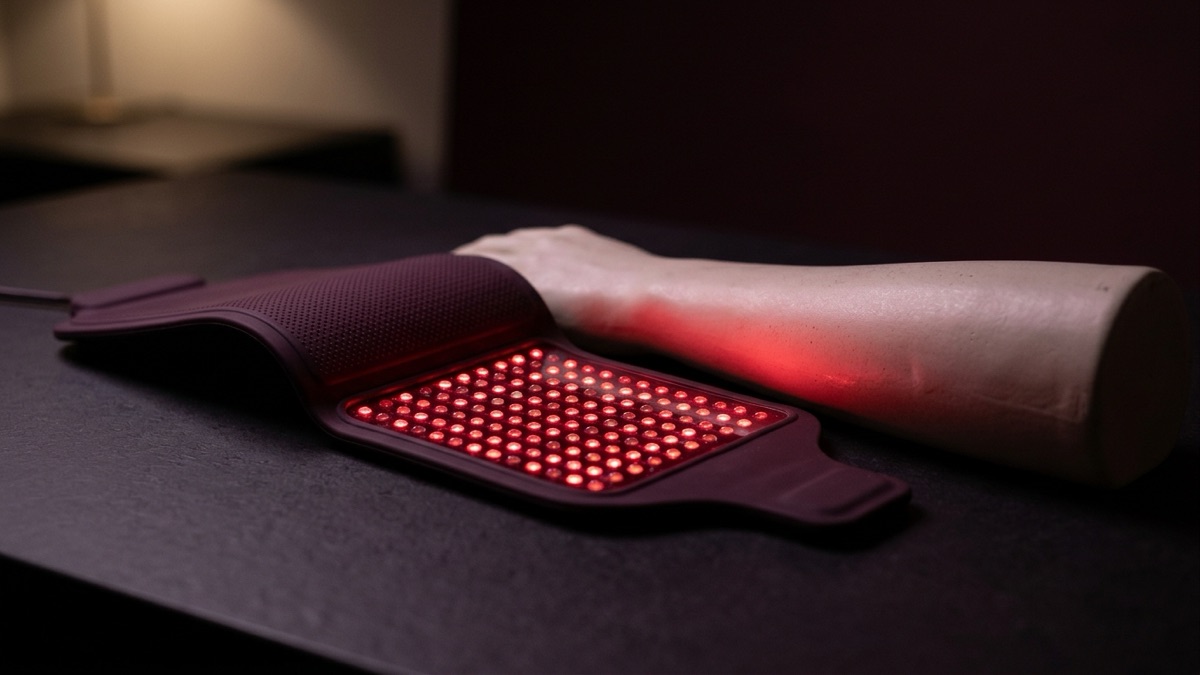
A scar is the body's repair job, and once it has formed it is slow to change. Red light therapy is marketed for scars anyway, usually with a photo pair and no study. There is a study. It has three people in it. Here is what it found, what the wider wound-healing evidence adds, and what to actually do with a mask or panel.
Quick answer
The direct evidence is thin: one case series treated raised scars in three people with 805 nm near-infrared light at 30 mW/cm2, daily for 30 days, and the treated scar improved more than the untreated one. Acute wound healing has stronger support (grade B). Red light may help texture and redness while a scar remodels; it does not erase scars.
Key takeaways
- The best-known scar study is a three-patient case series: 805 nm near-infrared LED, 30 mW/cm2, one scar treated daily for 30 days, the other scar as a control, with significant improvement on the treated side and no adverse effects.
- Acute wound healing earned a grade B in the 2018 systematic analysis of 31 LED trials; scars and most other skin conditions sat at grade C or D.
- Near-infrared (780 to 950 nm) reaches deeper than red, which is why the scar study used it: scar tissue sits in the dermis.
- What is plausible: softer, flatter, less red raised scars while they are still remodeling. What is not: filling pits, erasing a scar, or lightening a pigmented mark on its own.
- Keloids, open wounds and anything infected are a dermatologist's job first. Light comes later, if at all.
What kinds of scars are there, and does it matter?
It matters more than anything else in this guide, because the one study treated one kind.
| Scar type | What it is | What the evidence says | Realistic aim with light |
|---|---|---|---|
| Hypertrophic | Raised, red, stays within the wound edges, often after surgery or burns | The 3-patient case series (805 nm, daily for 30 days) treated this type and keloids after revision | Softer, flatter, less red while remodeling |
| Keloid | Raised and grows beyond the wound edges; can keep growing | Same case series, under a dermatologist, after surgical revision | Medical management first; never a home experiment |
| Atrophic and pitted (ice pick, boxcar acne scars) | Missing tissue, a depression | No light evidence; procedures (needling, fillers, resurfacing) are the field | None from light alone |
| Post-inflammatory marks after acne | Red or brown flat marks, not true scars | Red light has some acne evidence; marks fade with normal healing | Possibly faster fading of redness; pigment is a separate problem |
| Fresh healing wound (closed) | Days to weeks old, still remodeling | Acute wound healing graded B across LED trials | Supporting the healing phase; never on open or infected skin |
| Old, flat, pale | Years old, settled | No trials | Low expectations |
If your scar is raised and recent, the small evidence that exists applies to you. If it is a pit, a pale line from a decade ago, or a keloid, read on for the honest reasons to expect little, or to see a dermatologist.
What did the three-patient scar study actually do?
Barolet and Boucher published it in 2010. Three patients aged 27 to 57, with light to medium skin, had hypertrophic scars or keloids from acne or surgery on both sides of the body: paired pre-auricular keloids after a face lift, paired chest scars after resurfacing for acne, paired back scars after excision and resurfacing. After the surgical or laser treatment, each patient treated one scar at home every day for 30 days with an 805 nm near-infrared LED at 30 mW/cm2, a dose the Avci review reports as 27 J/cm2 per session, and left the matching scar untreated as the control. Scars were assessed for up to a year.
The result, in the authors' words, was significant improvement on the near-infrared treated scar compared with the control scar on all efficacy measures, with no significant treatment-related adverse effects. That is encouraging and it is also three people, no blinding described in the abstract, and scars that had just been surgically revised, so they were in the active remodeling phase where any intervention has the most room to work. The study says "prophylactic" in its title for a reason: it treated scars as they formed, not scars that had sat for years.
What does the wider evidence add?
Two things. First, wound healing. The systematic review by Jagdeo and colleagues, published in 2018, looked at 31 randomized controlled trials of LED therapy in dermatology and gave acute wound healing a grade B, alongside acne and herpes; every other skin condition, scars included, received a C or D. The Avci review describes small studies in which LED treatment sped re-epithelialization after laser injury and burns, though some of those reports rest on patient and physician impressions rather than measurements. The honest reading is that light can support the healing phase of a fresh, closed wound, and that a scar is what remains after that phase ends.
Second, why near-infrared. Chung and colleagues describe wavelengths of 600 to 700 nm as suited to superficial tissue and 780 to 950 nm as the band that penetrates further. Scar collagen sits in the dermis, below the surface the red band mostly treats, which is why the one scar study used 805 nm rather than 630. The infrared vs red light guide explains the two bands; for scars, the near-infrared side of your panel is the relevant one.
One more data point, from the other direction. In the 136-volunteer skin trial by Wunsch and Matuschka, one person reported reddening of a 40-year-old knee scar after red light sessions; it healed within a week. Old scar tissue can react, usually mildly, and that is a reason to start short and watch.
What can red light plausibly do for a scar, and what can it not?
Plausible, with thin evidence: a raised scar that is still remodeling may end up softer, flatter and less red than it would have otherwise, and redness around a recent scar may settle faster. Those are the things the case series measured and the mechanism supports: near-infrared acting on fibroblasts and inflammation in the dermis.
Not plausible: light does not add tissue to a pit, cut a keloid down, or lighten brown pigment on its own. Pitted acne scars respond to procedures that remodel or fill the dermis; pigment responds to sun protection, time and topical treatments a dermatologist chooses. If a product page shows an ice-pick scar vanishing under an LED mask, the photo is doing the work, not the light.
Fun fact
The title of the only scar study says "prophylactic", meaning preventive. The researchers were not trying to remove scars; they were trying to shape how a fresh scar formed. That is a different, and more realistic, promise than the one on most boxes.
How should you use a device on a scar?
Only on closed, intact skin, and only after a dermatologist has seen anything raised that is growing. Then borrow the one protocol that exists and adapt it to your device.
| Variable | The case series | How to match it at home |
|---|---|---|
| Wavelength | 805 nm near-infrared | Use the near-infrared band (810, 830 or 850 nm); red alone is the wrong depth |
| Irradiance | 30 mW/cm2 at the skin | A panel's spec figure at 6 inches, corrected for your distance; a wrap or mask gives its spec figure directly |
| Dose per session | 27 J/cm2 | 27 J/cm2 at 30 mW/cm2 is 15 minutes; at 60 mW/cm2 it is about 7.5 minutes |
| Frequency | Daily | Daily or five days a week; consistency beats intensity |
| Duration | 30 days, assessed for up to a year | A 30-day block, photographed at day 0 and day 30, then decide |
Work out your minutes with the dosage guide rather than guessing: a panel that delivers 100 mW/cm2 at 6 inches gives 27 J/cm2 in under five minutes at that distance, and in about 18 minutes at 12 inches. Photograph the scar with a ruler beside it, same light and angle, using the method in the progress photo guide, and judge at 30 days, not 3.
Try it
Put your device's irradiance and the 27 J/cm2 target into the free dose calculator; it shows the minutes at your distance and flags whether you are in the range the reviews cite.
Heads up
Never treat an open, weeping or infected wound, a surgical site before your surgeon says it has closed, or a scar that is growing, itching or changing shape without a dermatologist's opinion first; keloids especially. Never stare into LEDs or laser diodes, wear the goggles that come with a high-power panel, and keep devices out of children's reach. Device makers list pregnancy, epilepsy, active cancer, photosensitive conditions and photosensitizing medication as contraindications; if any applies, talk to a doctor before you start. These guides describe what trials measured; they are not medical advice.
What about acne scars specifically?
Split the question in two. Active acne and the red marks it leaves have the better evidence: the Jagdeo systematic review graded acne B, mostly for red plus blue light, and the Avci review reports a trial in which 630 nm red light at 12 J/cm2 twice a week for 12 sessions, with a topical antibiotic, significantly reduced active lesions. Fewer breakouts means fewer new marks, and red light may help the redness of fresh marks settle. The acne guide covers that protocol.
True acne scars, the pits and rolling depressions, are missing dermis. No LED mask or panel has been shown to fill them, and the honest advice is to spend the money on a dermatologist's assessment rather than on a stronger light. The skin hub grades every skin goal in one table so you can see where scars sit against texture, acne and wrinkles.
When should a scar see a doctor before it sees a light?
If it is growing beyond the original wound, itching or painful, changing color unevenly, or less than a few weeks old and still scabbed or weeping. If it is a keloid or you have had keloids before. If it is on a child. And if it is a mole, a mark you are not sure is a scar, or anything that has changed recently: that is a skin check, not a light session. The wound healing guide explains where the healing evidence ends and medical care begins.
The RedLightLog app, coming to Android first, will time a daily 30-day scar block and keep the day 0 and day 30 photo pair side by side.
Red light therapy for scars rests on three people, one wavelength and 30 days. That is enough to justify a careful, cheap experiment on a recent raised scar with the near-infrared side of a device you already own, at about 27 J/cm2 a day, photographed honestly. It is not enough to promise anything, and nothing in the evidence suggests a light will remove a scar that has already settled.
RedLightLog guides describe what published trials measured and how to use a device consistently. They are not medical advice, do not diagnose or treat any condition, and do not promise results; "FDA cleared" means a device was found substantially equivalent to an earlier device, not that an outcome is proven. Never stare into LEDs or laser diodes, and talk to a doctor first if you are pregnant, have epilepsy, an active cancer or take photosensitizing medication.
Questions people ask
Does red light therapy help scars?
The direct evidence is thin: a case series of three people treated raised scars daily for 30 days with 805 nm near-infrared light and found the treated scar improved more than the untreated one on every measure. Acute wound healing has stronger evidence (grade B in a systematic review of LED trials published in 2018). Nothing shows it removes a scar.
Does red light therapy work on old scars?
Nobody has tested it well. The case series treated scars soon after surgery or laser resurfacing, when scar tissue is still remodeling. An old, pale, flat scar is settled tissue, and expectations should be low.
Can red light therapy help acne scars?
It depends which kind. Red light may help the red or dark marks that follow a breakout fade as part of normal healing, and it has some evidence for active acne. Pitted or ice-pick scars are missing tissue, and no light device fills them; those are a dermatologist's job.
What dose did the scar study use?
805 nm near-infrared LED at 30 mW/cm2, reported at 27 J/cm2 per session, which works out to about 15 minutes, once a day, for 30 days. Three patients, so treat it as a starting point, not a prescription.
Is red light safe to use on a keloid?
Keloids are a medical condition that can grow after any irritation, and the only evidence for light on them is a handful of patients treated under a dermatologist after surgical revision. See a dermatologist before shining anything at a keloid.
Where these facts come from
- Barolet and Boucher 2010, Prophylactic low-level light therapy for the treatment of hypertrophic scars and keloids: a case series (Lasers Surg Med, PubMed): pubmed.ncbi.nlm.nih.gov/20662038/
- Avci et al 2013, Low-level laser (light) therapy in skin: stimulating, healing, restoring (Semin Cutan Med Surg, PMC): pmc.ncbi.nlm.nih.gov/articles/PMC4126803/
- Jagdeo et al 2018, Light-emitting diodes in dermatology: a systematic review of randomized controlled trials (Lasers Surg Med, PubMed): pubmed.ncbi.nlm.nih.gov/29356026/
- Chung et al 2012, The nuts and bolts of low-level laser (light) therapy (Ann Biomed Eng, PMC): pmc.ncbi.nlm.nih.gov/articles/PMC3288797/
- Wunsch and Matuschka 2014, controlled trial of red and near-infrared light on skin (Photomed Laser Surg, PMC): pmc.ncbi.nlm.nih.gov/articles/PMC3926176/