Blog basics
Infrared vs Red Light Therapy: Wavelengths and Uses
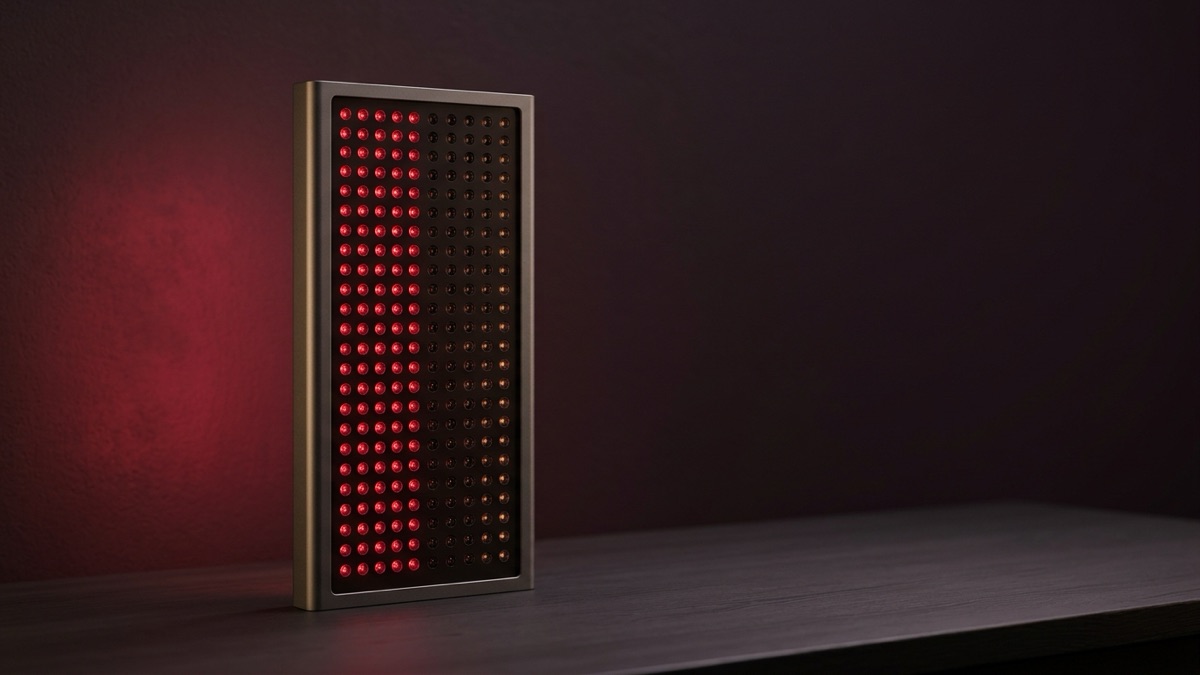
Your panel has two kinds of LEDs: some glow bright red, and some barely glow at all. The box calls one "red" and the other "near-infrared" or "NIR", and the marketing claims the invisible ones go deeper. That part is roughly true. The rest needs unpacking.
Quick answer
Red light (about 600 to 700 nm) is visible and acts mostly in the skin; near-infrared (about 770 to 1200 nm) is invisible and penetrates further, into deeper tissue. Both are photobiomodulation and most panels emit both. The skin and hair trials used red; a scar case series used 805 nm near-infrared. An infrared sauna is a different thing: heat.
Key takeaways
- Red and near-infrared are two bands of one treatment, photobiomodulation. Hamblin's review puts red at 600 to 700 nm and near-infrared at 770 to 1200 nm.
- Red works mostly in the skin; near-infrared reaches deeper. Chung and colleagues describe 600 to 700 nm for superficial tissue and 780 to 950 nm for deeper targets.
- The best-known skin trials used red (611 to 650 nm, 633 nm) and the hair trials used 655 nm; the scar case series used 805 nm near-infrared.
- Near-infrared is invisible, so a dim 850 nm LED is still working, and brightness tells you nothing about eye exposure.
- An infrared sauna uses longer-wavelength infrared you feel as heat. It is not photobiomodulation.
What is the difference between red and near-infrared light?
Light is described by its wavelength in nanometers (nm). The visible spectrum runs from violet at about 400 nm to deep red near 700 nm. Beyond that, the eye stops responding, and the infrared region begins. Red light therapy devices use the red end of the visible band, and near-infrared devices use the first stretch of the invisible band just beyond it.
The research field treats both as one treatment, photobiomodulation. Michael Hamblin, whose group has written many of the reviews, defines it as the use of red and near-infrared light, and notes that wavelengths in the red (600 to 700 nm) and near-infrared (770 to 1200 nm) regions have shown positive results. The proposed mechanism is shared: both bands are absorbed by cytochrome c oxidase in the mitochondria and by light-sensitive ion channels, and both show the same biphasic dose response, where a moderate dose stimulates and a large one does not.
| Band | Wavelengths | Can you see it? | Typical targets | Trials that used it |
|---|---|---|---|---|
| Red | about 600 to 700 nm | Yes, bright red | Skin, scalp, superficial tissue | Wunsch 2014 (611 to 650 nm), Lee 2007 (633 nm), hair combs and helmets (655 nm) |
| Near-infrared | about 770 to 1200 nm | No, or a faint glow | Deeper tissue: joints, muscle, scars | Barolet 2010 (805 nm), Lee 2007 (830 nm), knee laser trials (785 to 860 and 904 nm) |
| Far infrared | thousands of nm | No, felt as heat | Warming the body (saunas) | Not photobiomodulation |
Why does near-infrared go deeper?
Tissue scatters and absorbs short wavelengths more than long ones, and the main pigments in skin (melanin and hemoglobin) absorb strongly in the visible range and less so beyond it. Chung and colleagues describe an "optical window" from about 600 to 1070 nm where light penetrates tissue best, and within it they split the jobs: 600 to 700 nm for superficial tissue, and 780 to 950 nm, which penetrates further, for deeper-seated targets.
"Deeper" is still measured in millimeters, not inches. Near-infrared reaches further into the dermis and subcutaneous tissue than red does, and some reaches muscle and joint capsule in thin areas like the knee or the hand, but claims that panel light reaches internal organs deserve skepticism. The penetration depth guide goes through what has been measured.
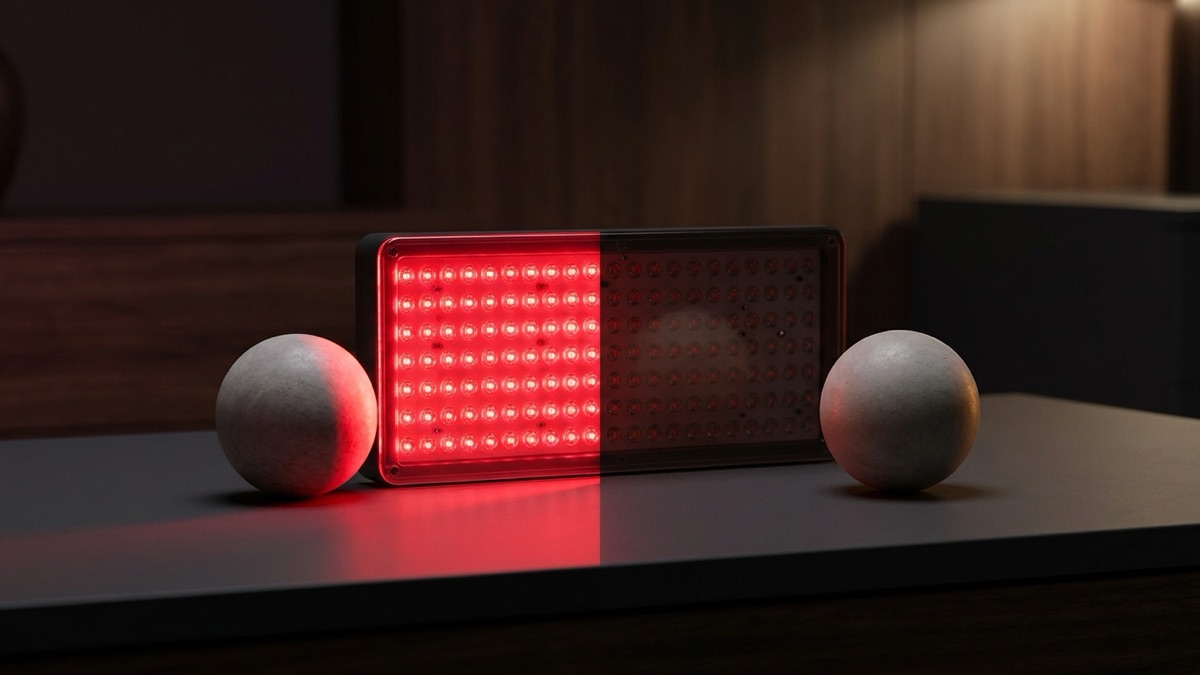
Which wavelengths did the trials use?
This is where the "red vs infrared" question gets useful, because the trials did not use both equally.
Skin. The largest controlled trial, Wunsch and Matuschka's 136-volunteer study, compared two kinds of light unit: red-only units emitting 611 to 650 nm, and broad-spectrum units emitting 570 to 850 nm, which included near-infrared. Both groups improved on collagen density, roughness and blinded wrinkle grading compared with untreated controls, and the authors report that the broad spectrum showed no advantage over the red-light-only spectrum. The trial was funded by a device manufacturer, and the controls were not randomized, so read it as suggestive rather than settled. Lee's split-face trial used 830 nm, 633 nm or both, and found improvement in all three active groups.
Hair. The pattern hair loss trials used red: 655 nm laser combs three times a week for 26 weeks, and a 655 nm laser and LED helmet every other day for 16 weeks. The helmet trial reported a 39 percent hair count increase against placebo. There is no equivalent body of near-infrared hair trials.
Scars. The small evidence here is near-infrared: Barolet and Boucher treated one scar on each of three patients daily for 30 days with 805 nm LED at 30 mW/cm2 and reported significant improvement over the untreated control scar. Three people, so a starting point only; the scars guide has the detail.
Joints. The knee osteoarthritis meta-analysis pooled 22 laser trials at 785 to 860 nm and 904 nm, both near-infrared, and found pain fell more at the recommended doses per point. Lasers dosed per point are not panels, but the band they chose tells you where the field thinks deeper targets live.
The pattern: red for skin and scalp, near-infrared for anything under the skin, and both when a device offers both and the target is mixed.
Should you run red, near-infrared or both?
If your device lets you choose, match the band to the target rather than running everything on principle. Face and scalp: red, or red plus near-infrared if your device pairs them, since the strongest skin trials used red and the broad spectrum added nothing measurable. Knee, shoulder, back, scar: near-infrared, or both. Whole-body sessions: both, because you are treating skin and deeper tissue at once.
Two practical notes. First, when both bands run together the dose adds up, so a 10 minute session at 100 mW/cm2 of combined output is a 60 J/cm2 session, which is at the top of the range most reviews cite; the dosage guide explains how to work it out. Second, most panels fix the wavelengths and let you switch red or near-infrared off, so "which one" is often the only choice you actually have. The 660 nm vs 850 nm guide goes through the two most common pairings.
Try it
The free dose calculator takes your panel's irradiance and distance and shows the dose per session, so you can see what switching a band on or off does to the number before you change your minutes.
Fun fact
The faint glow you see from a near-infrared LED is not the near-infrared. Most 850 nm emitters leak a little visible light at the edge of their output, which is the dim red you notice. The main emission is outside your vision entirely.
Is an infrared sauna the same thing?
No, and the shared word causes real confusion. Infrared is a wide region. Near-infrared sits right next to visible red, and photobiomodulation lives there, at 600 to 1200 nm. Infrared saunas use heaters that emit mostly much longer wavelengths; NASA's spectrum pages note that humans detect infrared as heat and that Earth scientists call the 8 to 15 micrometer band thermal infrared, which is thousands of nanometers beyond anything a red light panel emits. A sauna warms you; a panel delivers a dose to cells without heating tissue much at all. Both can be pleasant. They are not interchangeable, and a sauna session does not count toward a red light protocol. The red light therapy vs infrared sauna guide compares them properly.
Heads up
Near-infrared is invisible, which makes it the band to respect around the eyes: a panel that looks dim can still be delivering a strong dose to the retina if you look into it. Never stare into LEDs or laser diodes, wear the goggles that come with a high-power panel, and never shine any device into an eye to treat an eye condition at home. Device makers list pregnancy, epilepsy, active cancer, photosensitive conditions and photosensitizing medication as contraindications; talk to a doctor first if any of those applies, or if a symptom is getting worse. These guides describe what trials measured; they are not medical advice.
What does this mean for your device?
Read the spec sheet for the wavelength list, not the color names. "Red" usually means 630 or 660 nm, "near-infrared" usually means 810, 830 or 850 nm, and a few panels add 1060 nm or a blue band. For face and scalp, make sure red is on; for a joint or a scar, make sure near-infrared is on; and whatever you run, keep the distance and minutes constant for four weeks so you are testing the wavelength and not the wobble. The red light therapy guide puts the four variables together.
The RedLightLog app, coming to Android first, will store the wavelengths and irradiance of your device so every logged session carries the band and the dose.
Red and near-infrared are two bands of the same treatment, split by one fact: the eye can see one and tissue lets the other travel further. Use red for skin and hair, where the trials are, near-infrared for whatever lies beneath, and leave the sauna in its own category.
RedLightLog guides describe what published trials measured and how to use a device consistently. They are not medical advice, do not diagnose or treat any condition, and do not promise results; "FDA cleared" means a device was found substantially equivalent to an earlier device, not that an outcome is proven. Never stare into LEDs or laser diodes, and talk to a doctor first if you are pregnant, have epilepsy, an active cancer or take photosensitizing medication.
Questions people ask
Is infrared light therapy the same as red light therapy?
They are two bands of the same treatment. Red light (about 600 to 700 nm) is visible and works mostly in the skin; near-infrared (about 770 to 1200 nm) is invisible and penetrates further. Most home panels emit both, and the research field calls the whole thing photobiomodulation.
Which is better, red or near-infrared?
It depends on the target. The skin and hair trials mostly used red light around 630 to 660 nm; the scar case series used 805 nm near-infrared; deeper joint and muscle work leans on near-infrared. In the largest skin trial, adding a broad spectrum showed no advantage over red light alone.
Why does the near-infrared side of my panel look off?
Because near-infrared is beyond what the eye can see. A faint red glow from an 850 nm LED is normal; it is still emitting. That is also why you cannot judge eye exposure by brightness.
Is an infrared sauna the same as near-infrared light therapy?
No. An infrared sauna heats you with longer-wavelength infrared that you feel as warmth. Photobiomodulation uses red and near-infrared light at 600 to 1200 nm to act on cells, not to heat tissue. They are different tools for different jobs.
Where these facts come from
- Hamblin 2017, Mechanisms and applications of the anti-inflammatory effects of photobiomodulation (AIMS Biophys, PMC): pmc.ncbi.nlm.nih.gov/articles/PMC5523874/
- Chung et al 2012, The nuts and bolts of low-level laser (light) therapy (Ann Biomed Eng, PMC): pmc.ncbi.nlm.nih.gov/articles/PMC3288797/
- Wunsch and Matuschka 2014, controlled trial of red and near-infrared light on skin (Photomed Laser Surg, PMC): pmc.ncbi.nlm.nih.gov/articles/PMC3926176/
- Barolet and Boucher 2010, prophylactic near-infrared LED for hypertrophic scars and keloids, case series (Lasers Surg Med, PubMed): pubmed.ncbi.nlm.nih.gov/20662038/
- Lanzafame et al 2013, 655 nm laser and LED helmet for hair growth in males (Lasers Surg Med, PubMed): pubmed.ncbi.nlm.nih.gov/24078483/
- NASA Science, Infrared waves (the electromagnetic spectrum): science.nasa.gov/ems/07_infraredwaves/