Blog basics
How Often to Do Red Light Therapy: Frequency by Goal
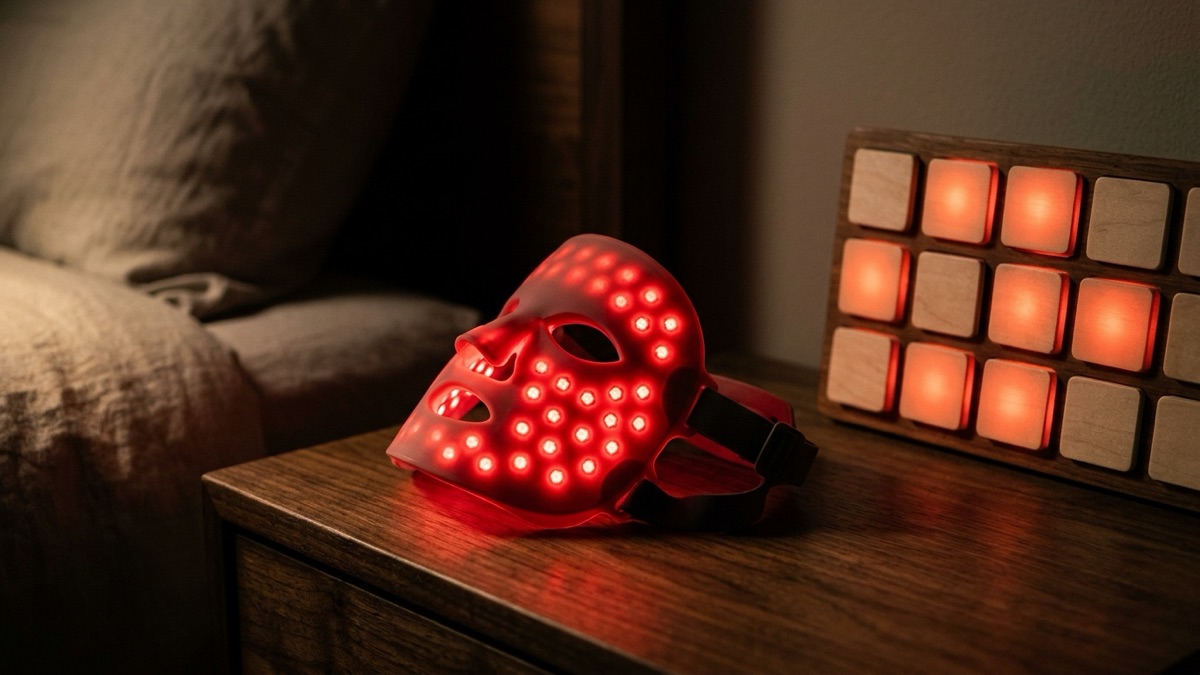
You bought the mask, or the panel is leaning against the bedroom wall, and the leaflet says something vague about "regular use". Regular is not a number. The trials that found anything used specific schedules, and they differ by goal.
Quick answer
Most skin trials used two to five sessions a week for four to fifteen weeks. Hair trials used three sessions a week, or every other day, for sixteen to twenty-six weeks. Knee pain trials ran several weeks; the one sleep trial used light nightly for fourteen nights. Three to five sessions a week covers most goals; more is not better.
Key takeaways
- Frequency in the trials ranged from twice a week (skin) to nightly (sleep). Three to five sessions a week is the honest middle for most goals.
- Duration matters as much as frequency: four weeks is the shortest block that tells you anything, and hair needs four to six months.
- More light does not mean more effect. The dose response is biphasic, so stacking sessions can blunt the result.
- The same schedule means little without the same dose. Fix your distance and minutes first, then fix your days.
- Four weeks of the same protocol, photographed at week 0 and week 4, is the test. Then decide whether to run another block.
What did the trials actually do each week?
"How often" is the question everyone asks and almost no leaflet answers with a trial behind it. Here is what the studies that measured something did, with their size, because a schedule from 136 people means more than one from 3.
| Goal | Sessions a week | Session | How long | Trial |
|---|---|---|---|---|
| Skin: collagen, roughness, wrinkles | 2 | 12 to 25 minutes, about 9 J/cm2 of red light | 30 sessions (about 15 weeks) | Wunsch and Matuschka 2014, 136 volunteers |
| Skin: wrinkles, elasticity | 2 | 830 nm, 633 nm or both | 4 weeks | Lee 2007, 76 patients, split-face |
| Hair: pattern hair loss | 3 | Whole scalp with a 655 nm laser comb | 26 weeks | Jimenez 2014, 269 randomized |
| Hair: pattern hair loss | Every other day | 25 minutes, 655 nm helmet, 67.3 J/cm2 | 16 weeks (60 sessions) | Lanzafame 2013, 44 men |
| Sleep | Every night | 30 minutes whole body, 658 nm, 30 J/cm2 | 14 nights | Zhao 2012, 20 athletes |
| Scars | Every day | 805 nm near-infrared at 30 mW/cm2 | 30 days | Barolet and Boucher 2010, 3 patients (see the scars guide) |
Two things jump out. First, nobody in these trials did a session once in a while. Second, the trials that looked at slow tissue (hair) ran for months, not weeks. If you are planning a schedule, copy the frequency from the row that matches your goal and copy the duration too.
Why is more not better?
Red light therapy has a biphasic dose response. Hamblin's group reviewed the evidence in 2009 and found that fluences as low as 3 to 5 J/cm2 were beneficial in living tissue, while 50 to 100 J/cm2 could lose the benefit and even become detrimental. Too little light does nothing, a moderate amount stimulates, and too much inhibits.
That curve applies within a session (how many joules you deliver) and, less precisely, across a week. The trials that worked were consistent rather than heroic: two to five sessions, the same dose each time, for a fixed number of weeks. There is no trial showing that two sessions a day beat one, and the shape of the curve argues against it. If you have a spare evening, spend it on the week 4 photos, not a seventh session.
How often should you do red light therapy for skin?
The two largest skin trials both used twice a week, and they got there by different routes. Wunsch and Matuschka ran 30 sessions twice a week with units delivering about 9 J/cm2 of red light (611 to 650 nm) per session; collagen density measured by ultrasound rose in both treated groups and fell slightly in the untreated controls, and blinded experts rated wrinkles better in 69 to 75 percent of treated volunteers against 4 percent of controls. Two caveats: the controls were not randomized and received no treatment, and the study was fully funded by a device manufacturer. Lee's split-face trial treated 76 people twice a week for four weeks with 830 nm, 633 nm or both, and measured wrinkle reduction of up to 36 percent on the treated side.
Device makers tend to recommend more, typically three to five sessions a week for four to six weeks for a mask. Nothing in the trials says five is wrong, but nothing says it beats two either. A sensible plan for skin is three or four sessions a week on fixed days, 10 minutes with a mask or 10 minutes at the distance your panel's spec was measured, for twelve weeks, with photos at weeks 0, 4, 8 and 12. The how long to do red light therapy guide works through the minutes.
How often for hair?
Hair is the goal with the best frequency data and the longest timelines. The 655 nm laser comb trials treated the whole scalp three times a week for 26 weeks; at the end, the device groups had gained roughly 18 to 26 more terminal hairs per square centimeter than the sham groups. The helmet trial ran 25 minute sessions every other day for 16 weeks and found a 39 percent hair count increase against placebo (35 percent after one outlier was removed). A 2021 meta-analysis of seven sham-controlled trials of cleared home devices found a significant increase in hair density across comb and helmet designs.
So: three sessions a week, or every other day, with the session length your device's manual gives, for at least 16 weeks. One early study reported a temporary increase in shedding in the first one to two months, so a worse-looking week 6 is not the moment to stop. The red light therapy for hair loss hub grades the whole evidence base and explains who tends to respond.
How often for pain and recovery?
Here the honest answer is "the trials used lasers, and you probably own a panel". The knee osteoarthritis meta-analysis (22 trials, 1,089 participants) found that pain fell more when the laser dose per treatment point was in the recommended range than below it, and that the effect peaked two to four weeks after therapy ended. Frequency varied by trial, and lasers dosed per point do not translate directly to a panel at 12 inches.
What you can do is borrow the structure: a fixed block of four to eight weeks, three to five sessions a week, 10 to 20 minutes per area at a distance that puts your panel's irradiance in a sensible range, then reassess with a pain score rather than a feeling. The red light therapy for pain hub covers the dose question properly. A joint that is getting worse, or any numbness or weakness, needs a diagnosis, not a longer session.
How often for sleep?
One small trial. Twenty female basketball players got 30 minutes of whole-body red light (about 658 nm, 30 J/cm2) every night for 14 nights; the red light group reported better sleep quality and had higher serum melatonin than the placebo group. Nightly for two weeks is therefore the only tested schedule, and twenty people is thin evidence. If you try it, keep it to the evening, keep the dose moderate, and judge it on a simple 1 to 5 "how rested" score each morning.
How long before you judge it?
Four weeks is the shortest block that means anything, and only for skin texture and pain. The skin trials ran four to fifteen weeks. The hair trials ran sixteen to twenty-six, and the hair follicle cycle means nothing visible happens for months. Pain scores in the knee trials kept improving for weeks after the course ended.
That shapes the schedule more than the exact day count does. Decide the block length before you start, write the end date down, and do not evaluate until you reach it. The before and after guide explains what changed in the trials and when, and how to take photos that let you see it.
Tip
Attach every session to a habit you already have. After brushing your teeth at night, before the morning shower, during the first ten minutes of a podcast. Schedules that depend on remembering fail in week three; schedules that piggyback on a habit survive.
A four-week starter plan
Pick the row for your goal, then do this:
- Fix the dose first. Find your device's irradiance on its spec sheet and work out the minutes you need with the dosage guide. The same frequency at a different distance is a different protocol.
- Choose fixed days. Monday, Wednesday, Friday beats "three times this week". For hair, every other day; for sleep, every evening.
- Take the week 0 photos or scores before the first session, in the same light and framing you will use at week 4.
- Log every session: date, minutes, distance, and one line on how the skin, scalp or joint felt.
- Do not change anything for four weeks. Not the distance, not the minutes, not the days.
- At week 4, compare, then run another block or stop. Hair gets at least four blocks before any judgment.
Try it
The free schedule builder turns your goal, your device and the days you can keep into a printable four-week calendar, flags a frequency outside what the trials used, and lists what to log.
Heads up
Never stare into the LEDs or laser diodes, even when a panel looks dim: near-infrared is invisible, so brightness tells you nothing about exposure. Wear the goggles that come with a high-power panel and never shine any device into an eye to treat an eye condition at home. Device makers list pregnancy, epilepsy, active cancer, photosensitive conditions and photosensitizing medication as contraindications; if any applies to you, or a symptom is getting worse, talk to a doctor before you start. These guides describe what trials measured; they are not medical advice.
What if you miss sessions?
Miss one and do nothing special. Miss a week and pick the schedule up again, but add a week to the end of your block before judging, and never double up to catch up, because the dose curve does not reward it. If you keep missing, the problem is the schedule, not your discipline: the routine guide is about building one that survives a bad week.
The RedLightLog app, coming to Android first, will time each session on the days you pick and keep the four-week calendar and the photo pair for you.
Frequency is the easy variable to get right, because the trials wrote it down: two to five sessions a week for skin, three a week or every other day for hair, nightly for the one sleep study, and a fixed block of weeks before you look. Pick the number you can keep, keep the dose the same, and let the calendar, not the leaflet, decide when you judge.
RedLightLog guides describe what published trials measured and how to use a device consistently. They are not medical advice, do not diagnose or treat any condition, and do not promise results; "FDA cleared" means a device was found substantially equivalent to an earlier device, not that an outcome is proven. Never stare into LEDs or laser diodes, and talk to a doctor first if you are pregnant, have epilepsy, an active cancer or take photosensitizing medication.
Questions people ask
How many times a week should I do red light therapy?
Three to five sessions a week covers most goals. The two largest skin trials used two sessions a week, the hair trials used three a week or every other day, and the one sleep trial used light every night for two weeks. Pick a number you can keep for at least four weeks.
Can you do red light therapy every day?
Some trials did, including the scar case series and the sleep trial, and the hair helmet trial used every other day. Daily use is not dangerous at trial doses, but it is not better either: the dose response is biphasic, so rest days are part of most protocols.
How many weeks until red light therapy shows a change?
The skin trials ran four to fifteen weeks, the hair trials sixteen to twenty-six weeks, and the knee pain trials measured at the end of several weeks of treatment. Four weeks is the shortest honest test for anything; hair needs far longer.
Is it better to do red light therapy in the morning or at night?
No trial has compared the two for skin or hair. The one sleep trial used light in the evening. Choose the time you can keep every week.
What happens if I miss a week?
Nothing dramatic. Pick the schedule back up rather than doubling sessions to catch up, and add the missed week to the end of your block before you judge the result.
Where these facts come from
- Wunsch and Matuschka 2014, controlled trial of red and near-infrared light on skin (Photomed Laser Surg, PMC): pmc.ncbi.nlm.nih.gov/articles/PMC3926176/
- Lee et al 2007, randomized split-face LED phototherapy study for skin rejuvenation (J Photochem Photobiol B, PubMed): pubmed.ncbi.nlm.nih.gov/17566756/
- Jimenez et al 2014, randomized sham-controlled trials of a 655 nm laser comb for pattern hair loss (Am J Clin Dermatol, PubMed): pubmed.ncbi.nlm.nih.gov/24474647/
- Lanzafame et al 2013, 655 nm laser and LED helmet for hair growth in males (Lasers Surg Med, PubMed): pubmed.ncbi.nlm.nih.gov/24078483/
- Zhao et al 2012, red light and sleep quality in female basketball players (J Athl Train, PMC): pmc.ncbi.nlm.nih.gov/articles/PMC3499892/
- Huang, Chen, Carroll and Hamblin 2009, Biphasic dose response in low level light therapy (Dose-Response, PMC): pmc.ncbi.nlm.nih.gov/articles/PMC2790317/