Free tool
Red light therapy dose calculator
Enter the irradiance from your spec sheet, your distance and your minutes. See the dose in J/cm2, how distance changes it, and how it compares with the ranges reviews and trials used for skin, acne, scars, hair, sleep and deep tissue.
How the calculator works
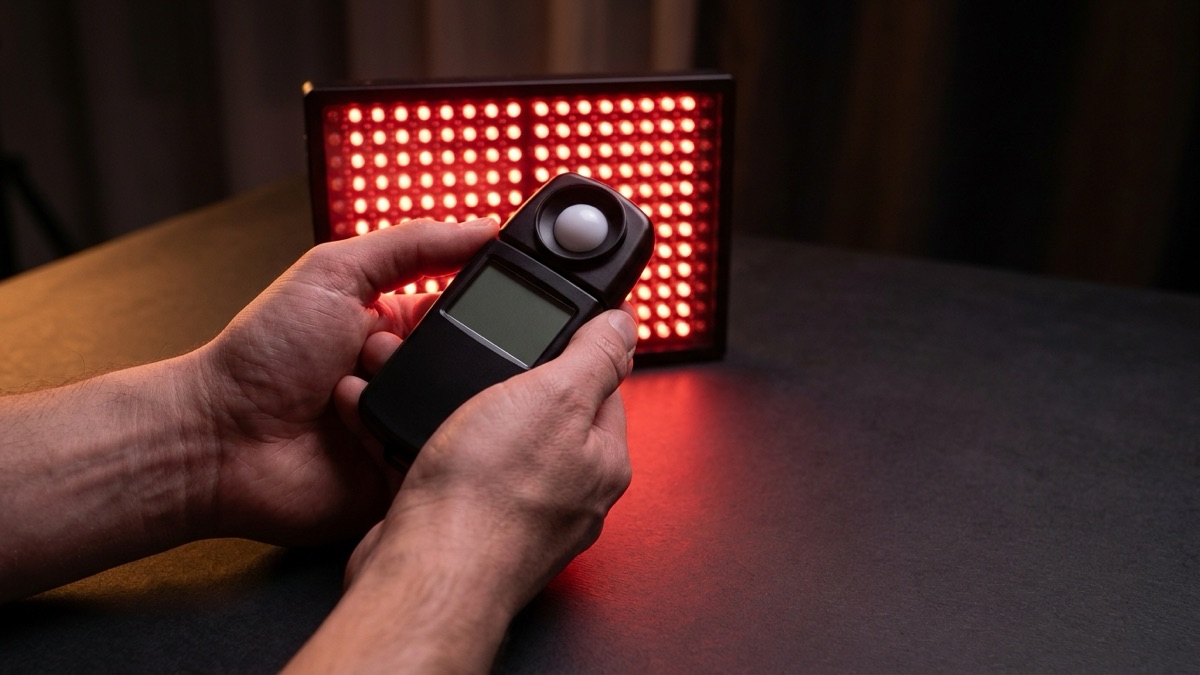
Red light therapy has one number that makers publish and one number that trials report, and they are not the same. Makers publish irradiance: the power landing on each square centimeter of skin, in milliwatts per square centimeter (mW/cm2), measured at some distance. Trials report dose (also called fluence or energy density): the total energy delivered to each square centimeter over the session, in joules per square centimeter (J/cm2). The bridge between them is time.
Dose (J/cm2) = irradiance (mW/cm2) x seconds / 1,000
A mask that delivers 30 mW/cm2, worn for 10 minutes (600 seconds), gives 30 x 600 / 1,000 = 18 J/cm2. A panel delivering 50 mW/cm2 at your distance gives the same 18 J/cm2 in 6 minutes.
Why distance matters so much
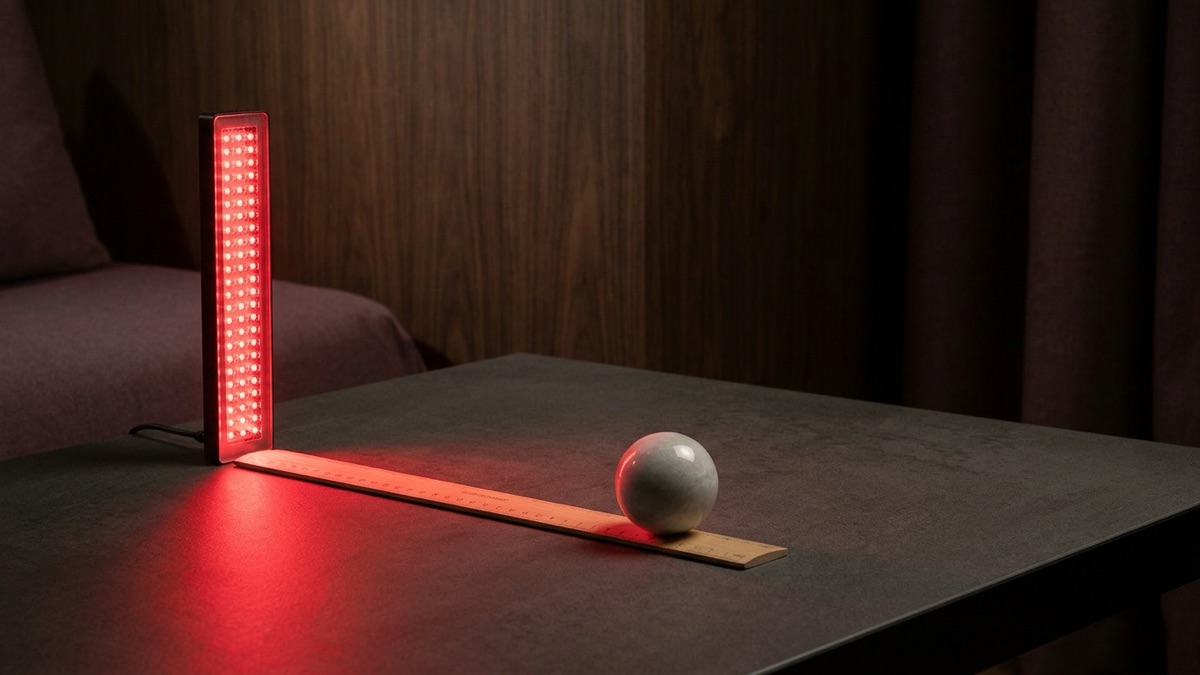
Light from a panel spreads out as it travels, so the irradiance at your skin falls with the square of the distance. If a spec sheet says 100 mW/cm2 at 6 inches, the same panel delivers about 25 mW/cm2 at 12 inches and about 11 mW/cm2 at 18 inches. Double the distance, quarter the dose. That is why a 10 minute session at 6 inches and a 10 minute session at 12 inches are not the same protocol, and why the calculator asks where the spec was measured and where you actually sit. Masks, wraps and wands sit on the skin, so their distance is fixed.
| If the spec sheet says | At 6 in | At 12 in | At 18 in | At 24 in |
|---|---|---|---|---|
| 50 mW/cm2 at 6 in | 50 | 12.5 | 5.6 | 3.1 |
| 100 mW/cm2 at 6 in | 100 | 25 | 11.1 | 6.3 |
| 150 mW/cm2 at 6 in | 150 | 37.5 | 16.7 | 9.4 |
Real panels fall off a little less steeply than a point source at very close range because they are wide, and makers measure in different ways, so treat the figures as a good estimate rather than a lab reading.
Where the target ranges come from
| Goal | J/cm2 per session | Where it comes from |
|---|---|---|
| Skin texture, lines, collagen | 4 to 20 | Reviews recommend 4 to 10 J/cm2 at the tissue; the largest controlled skin trial normalized to about 9 J/cm2 of red light, twice a week for 30 sessions |
| Acne (red light) | 10 to 15 | A red-light acne trial used 12 J/cm2 at 630 nm twice a week for 12 sessions |
| Scars (near-infrared) | 20 to 30 | A three-patient case series used 805 nm at 30 mW/cm2 for 27 J/cm2, daily for 30 days |
| Scalp hair | 40 to 70 | Two helmet trials used 67.3 J/cm2 every other day for 16 weeks and 47.9 J/cm2 daily for 24 weeks |
| Sleep (whole body) | 20 to 30 | One trial of 20 athletes used 30 J/cm2 nightly for 14 nights |
| Joints and deep tissue | 20 to 50 | Reviews cite up to about 50 J/cm2 at the surface and warn that 50 to 100 can lose the benefit; knee trials dosed lasers per point |
The overall field runs from about 3 to 60 J/cm2: fluences as low as 3 to 5 J/cm2 were beneficial in animal and human studies, while 50 to 100 J/cm2 could lose the benefit. That is the biphasic dose response, and it is the single most useful thing to know about red light: past a point, more light does less.
Heads up
Never stare into LEDs or laser diodes, even when the light looks dim: near-infrared is invisible, so brightness tells you nothing about exposure. Wear the goggles that ship with a high-power panel, keep devices away from children, and never shine a device into an eye to treat an eye condition at home. Talk to a doctor before you start if you are pregnant, have epilepsy, an active cancer, a photosensitive condition, or take medication that makes skin sensitive to light.
What the calculator cannot tell you
It cannot verify your maker's irradiance claim, which may have been measured at the LED surface, as a peak rather than an average, or with a sensor that reads high. It cannot account for your skin tone, hair, or how far light penetrates to the tissue you care about. And it cannot turn a laser trial's joules per point into a panel protocol exactly. Use it to get into a sensible range, keep the same settings for four weeks, log every session, and judge by photos and symptoms rather than by the number.
Where these numbers come from
The device presets quote two makers' public spec pages (an LED mask stated at about 30 mW/cm2; panels averaging about 38 to 57 mW/cm2 at 6 inches by an outside lab, read 2026-11-02). The target ranges come from the Huang 2009 biphasic dose-response review, the Zein 2018 light-parameters review, the Wunsch and Matuschka 2014 skin trial, the Avci 2013 skin review, the Barolet and Boucher 2010 scar case series, the Lanzafame 2013 hair trial, the Avci 2014 hair review, the Zhao 2012 sleep trial and the Stausholm 2019 knee meta-analysis. Each is linked inside the tool.
Questions
What is a good dose of red light therapy in J/cm2?
It depends on the goal. Reviews recommend 4 to 10 J/cm2 at the tissue for skin, the largest skin trial used about 9 J/cm2 per session, a scar case series used 27 J/cm2 of near-infrared, hair helmet trials used about 48 to 67 J/cm2, and reviews cite up to about 50 J/cm2 at the surface for deeper tissue. Doses of 50 to 100 J/cm2 can lose the benefit.
How do I convert mW/cm2 to J/cm2?
Multiply the irradiance in mW/cm2 by the session length in seconds and divide by 1,000. A 30 mW/cm2 mask worn for 10 minutes (600 seconds) delivers 18 J/cm2.
How far should I sit from a red light therapy panel?
At the distance the spec sheet was measured at if you want its stated irradiance, usually 6 inches. Irradiance falls with the square of the distance, so at 12 inches you get about a quarter of the 6 inch figure. One panel maker suggests 8 to 14 inches for deep tissue and 16 to 24 inches for facial skin; the calculator shows the dose at each.
Can I use the calculator for a mask or a wand?
Yes, if the maker publishes irradiance in mW/cm2. Masks and wands sit on the skin, so distance does not change the dose. If your device only lists total wattage or LED count, there is no honest way to calculate a dose, and that is worth knowing before you buy.
Does a higher dose work better?
Not past a point. The dose response is biphasic: too little does nothing, a moderate dose stimulates, and too much can inhibit the effect. Pick a dose inside the range for your goal and keep it the same for four weeks rather than pushing it up.